
The Importance of Achieving Airtightness for Energy Efficiency
This requires particular design and care from the construction team. We work with architects and designers to ensure building design is considered draught-free construction. Our high standard of workmanship can ensure that no gap or leakages are missed.
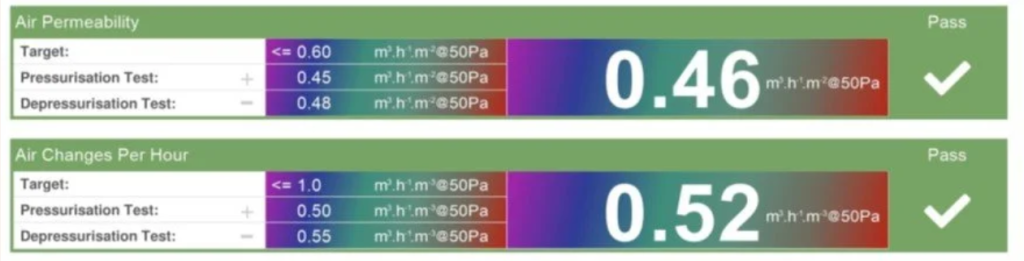
Our ongoing project, Dunstan Palace, is an example of one of our retrofits which greatly exceeded the passive house standard requirements for airtightness value. As a retrofit, these are more difficult in creating airtightness compared to a new home because of the need to work with existing structures. We a proud to say we achieved outstanding results which outperformed what would be needed for a new passive house home. Achieving an air permeability rating of 0.46 @ 50Pa and an air changes per hour of 0.52 @ 50pa. (The lower the score the less air exchanges).
Improving energy efficiency through retrofits can be achieved with the right construction techniques, skills, and knowledge. One effective measure is installing energy-efficient windows. Contact us for more information.
Sources
Your Home, Efficiency Matrix, Ecological Building Systems, Fu, X., Qian, X., & Wang, L. (2017). Energy Efficiency for Airtightness and Exterior Wall Insulation of Passive Houses in Hot Summer and Cold Winter Zone of China. Sustainability (Basel, Switzerland), 9(7), 1097–. https://www.mdpi.com/2071-1050/9/7/1097