
When people start planning a new home, the conversation often begins with what they can see.
The architecture. The kitchen. The finishes. The view. The number of bedrooms. The size of the living spaces.
All of these things matter. But some of the decisions that will have the greatest impact on how much you enjoy living in your home are almost invisible once the build is finished.
How hot will the bedrooms get on a summer afternoon?
Will the temperature change dramatically from one room to another?
Will you hear traffic, neighbours or outside noise?
Will the air inside feel fresh?
Will you need to constantly run heating or cooling just to stay comfortable?
Will condensation or moisture become an issue?
And will the finished home actually perform the way everyone said it would on paper?
At TZO, these questions are fundamental to how we think about a home.
Because ultimately, good architecture shouldn’t just look good.
It should be better to live in.
A high-end home isn’t automatically a high-performing home
There is an understandable assumption that spending more on a new home will naturally produce a better result.
Unfortunately, cost alone doesn’t guarantee comfort or performance.
You can invest heavily in architecture, premium appliances, beautiful stone, custom joinery and high-end finishes and still end up with rooms that overheat, areas that are difficult to keep comfortable or a home that relies heavily on heating and cooling.
That’s because many of the things that determine how a home performs are decided long before the finishes are selected.
Orientation matters.
Shading matters.
The size, position and performance of windows matter.
Insulation matters.
Airtightness matters.
Ventilation matters.
The quality of the building envelope matters.
And perhaps most importantly, the way all of these elements work together matters.
A better home isn’t created by adding one high-performance product to an otherwise conventional design.
It needs to be considered as a complete system.
Start with the way you want to live
We believe the design process should begin with the people who are going to live in the home.
How do you live now?
What works?
What frustrates you?
Where does your family naturally come together?
How much connection do you want between inside and outside?
Do you work from home?
Are there spaces that need to be particularly quiet?
How do you want your bedroom to feel on a hot summer night?
What do you want the house to feel like when it’s cold outside?
These aren’t questions that should be answered after the floor plan has been created.
They should help create it.
That’s one of the reasons TZO brings design, drafting and construction thinking together from the beginning.
A decision made during design has consequences during construction. And both ultimately affect the experience of living in the finished home.
When those disciplines are disconnected, opportunities can be lost early and become difficult—or expensive—to correct later.
Comfort can be designed
We often talk about comfort as though it’s subjective.
To some extent it is.
But many of the conditions that make a home comfortable can be deliberately designed.
Good orientation can help us use the sun when we want it and protect the home from it when we don’t.
Appropriate shading can dramatically change how a home behaves through the seasons.
High-performing windows can reduce unwanted heat transfer while still allowing natural light and connection to the outdoors.
A well-designed and carefully constructed building envelope can help maintain much more stable internal temperatures.
Airtight construction can reduce uncontrolled draughts and air leakage.
And properly designed ventilation can provide continuous fresh air without relying on gaps and leaks in the building to do the job.
The result isn’t about creating a house that’s sealed away from the outside world.
It’s about creating a home where the indoor environment is controlled deliberately rather than accidentally.
You can still open the doors.
You can still open the windows.
You can still connect the house to the garden and enjoy the climate when conditions are right. The difference is that when conditions aren’t right, the building itself is doing far more of the work.
Energy efficiency is an outcome, not the whole objective
Energy efficiency is important.
But we don’t believe it should be the only reason to build a high-performance home.
Using less energy to heat and cool a home is clearly beneficial. But consider what creates that reduction.
The home is better protected from outside temperature extremes.
Internal temperatures are more stable.
Uncontrolled air leakage is reduced.
Windows perform better.
Solar gain is better managed.
Ventilation is deliberate.
Those same decisions can contribute to a home that is quieter, healthier, more comfortable and simply more pleasant to occupy.
So rather than asking only:
“How much energy will this home save?”
We think there is a bigger question:
“What will this home actually be like to live in?”
That’s the question that matters for the next 10, 20 or 30 years.
What you can’t see can matter the most
One of the interesting things about building high-performance homes is that much of the important work eventually disappears.
Insulation gets covered.
Airtightness layers disappear behind linings.
Window installation details are finished over.
Junctions between different parts of the building become invisible.
Once the kitchen is installed, the floors are finished and the furniture arrives, you may never see those details again.
But you’ll experience the consequences of them every day.
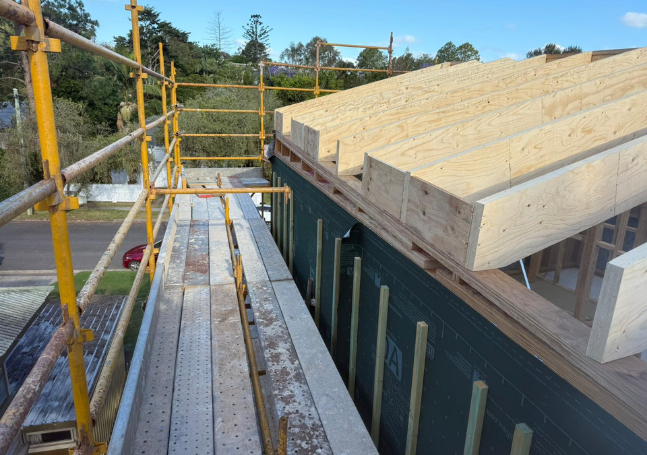
This is one of the reasons we like opening our projects while they’re under construction.
Walking through a home at this stage gives people an opportunity to see what normally disappears behind the finished surfaces.
You can see how the insulation is installed.
You can see how windows connect to the building envelope.
You can understand why seemingly small construction details matter.
A beautiful photograph can show you what a home looks like.
A construction site can begin to show you why it will perform the way it does.
Don’t just promise performance. Test it.
There is an important difference between hoping a home performs and knowing that it does.
Testing.
At TZO, testing and verification form an important part of our approach to high-performance construction.
A blower door test, for example, allows us to measure the airtightness of the building envelope.
Instead of simply saying the home has been carefully constructed, we can test the result.
This philosophy is strongly influenced by Passive House—an evidence-based approach to designing and constructing buildings for very high levels of comfort and energy performance.
But you don’t need to arrive at TZO asking for a certified Passive House.
Many people don’t.
What matters is understanding that the principles behind high-performance construction can help us make better decisions across many different types of homes.
The objective isn’t to chase a label.The objective is to build a better home.
There isn’t only one way to build with TZO
Not everyone comes to us with the same project, budget or starting point.
Some clients have a block of land and want a completely bespoke home designed around their family, site and ambitions.
For those projects, TZO can take the process from design and drafting through to construction, bringing performance thinking into the project from the very beginning.
Other people want the benefits of TZO’s design and high-performance thinking but don’t necessarily need—or want—to begin with a completely blank sheet of paper.
That’s why we created TZO Homes.
The design thinking has already begun. Instead of starting from nothing, clients can begin with a resolved TZO home and explore how it can work for their site and lifestyle.
And then there are people who already have an architect, a design, a builder or an owner-builder pathway in place.
For them, TZO Prefab provides another way to access our high-performance building knowledge through a prefabricated building system.
Different projects.
Different starting points. But the same fundamental objective.
Build for the experience, not just the photograph
A new home is one of the biggest investments most people will ever make.
Of course it should be beautiful.
Of course the kitchen matters.
The materials matter.
The architecture matters.
But eventually the photographs are taken, the boxes are unpacked and everyday life begins.
You’ll live there through Brisbane summers and Melbourne winters.
On hot nights and cold mornings.
With children sleeping, people working, friends arriving, doors opening and everyday life happening around you.
That’s the real test of a home.
So if you’re starting to think about building, we’d encourage you to look beyond the floor plan and finishes and ask a few different questions.
How will this home feel?
How will it perform?
And how will we know?
Those questions can change the entire direction of a project.
They’re also at the heart of what we mean when we say: A better home to live in
Thinking about building?
Whether you’re considering a completely custom home, exploring TZO Homes or looking for a high-performance prefabricated system for your own project, the best place to start is understanding what’s possible for you, your site and the way you want to live.
Explore the ways to build with TZO or talk to our team about your project.
